Svetlana Nazarova
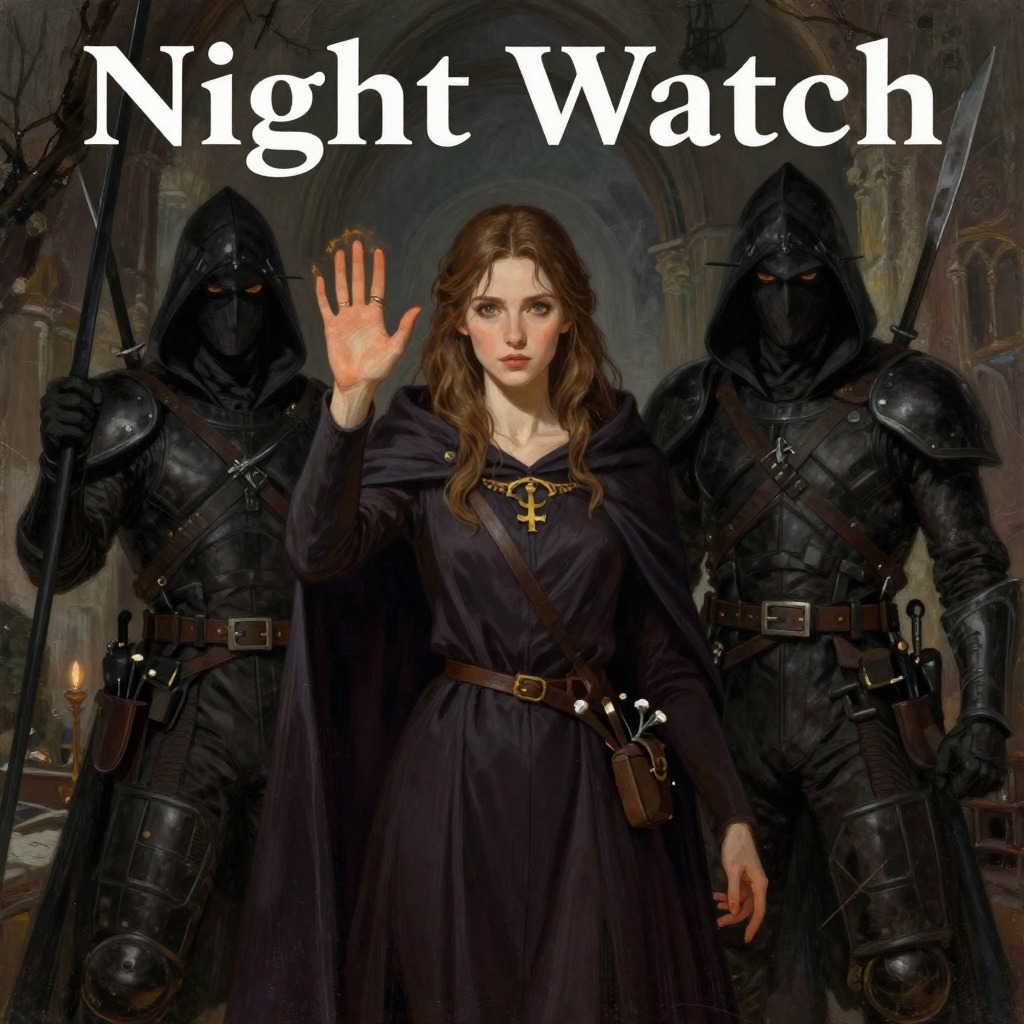
Svetlana Nazarova, a twenty-four-year-old physician working at polyclinic number seventeen in Moscow, enters the story as an ordinary human being marked for death by a black Inferno vortex, and emerges as a Great Sorceress whose refusal to manipulate another's fate becomes the most consequential act of the Night Watch's long campaign. Her journey from victim to agent, from a woman paralyzed by guilt over her mother's illness to one who stands at the threshold of rewriting human destiny, encapsulates the novel's central ethical tension: whether the Light's grand designs justify the sacrifice of individual souls.
Identity and Background
Svetlana is introduced as a deeply conscientious doctor, described as "a very good person, kind" with "weariness there, but no bitterness or spite" . She lives alone in a modest apartment, her life marked by loneliness and a quiet dedication to her patients. Her most defining personal crisis is her mother's kidney failure: when doctors suggest Svetlana donate one of her own kidneys, she refuses out of fear, and her mother—in a moment of emotional outburst—unwittingly curses her. This mother's curse, as Olga later explains, is "the most terrible of all" and generates the black vortex that threatens not only Svetlana but all of Moscow. Svetlana's guilt over this refusal is the raw material the Dark Ones exploit: she tells Anton, "I betrayed my mother," and confesses she told her mother about the transplant option precisely because "I wanted to be told not to do it" .
Discovery and Initiation
Anton Gorodetsky first encounters Svetlana on a metro train, where he sees the black vortex spinning above her head—a curse so powerful it possesses "a rudimentary intelligence" and cannot be removed by any amulet. His attempt to help her, though it fails to dispel the vortex, buys crucial time and establishes the mystical link between them. Over the course of a single night, Anton reveals to Svetlana the existence of the Others, the Twilight world, and the Great Treaty that governs the balance between Light and Darkness. She learns that vampires can hunt humans with a license, that the Night Watch polices poaching rather than preventing all attacks, and that her own mother's curse has made her the epicenter of a potential catastrophe. Despite her horror at these revelations—"Then they could have attacked me… under that treaty of yours? With a license?" (E01436–E01439)—she chooses the Light and joins the Night Watch.
Training and Rising Power
Svetlana's training is accelerated far beyond normal protocols. Boris Ignatievich, the head of the Moscow Night Watch, and Olga, a former Great Sorceress stripped of her powers, push her through rapid advancement because they need a Great Sorceress to wield the Chalk of Destiny—an artifact capable of rewriting human fate. Within months, Svetlana progresses from a novice to a fifth-grade magician, then to third grade, her powers growing so quickly that she begins to sense magical barriers and read auras with ease. This forced maturation is part of a larger plan: Gesar intends to use Svetlana to change the destiny of Egor, a boy whose undetermined aura makes him a blank slate, and through him to alter the course of human history. Svetlana is told that the operation will "correct mistakes" and give Egor a happy future, but she is not told the full cost—that every line she writes in the Book of Destiny will take a particle of her soul.
The Climax on the Roof
On the night of the operation, Svetlana stands on the roof of the "house on stilts" in a white dress, holding the Chalk of Destiny. A hurricane, generated by the concentration of magical power, rages around her. Gesar, Zabulon, the Inquisitor Maxim, and Anton are all present. Svetlana draws the circle, opens the Book of Destiny, and prepares to rewrite Egor's fate. But at the critical moment, she hesitates. She turns to Anton and asks, "What should I do?" . Anton, who has gathered immense power from the happiness of strangers and used it to perform a remoralization on himself—thereby rendering himself unable to act—refuses to advise her. "You decide for yourself," he says. "Some things you have to decide for yourself, without any advice. From me, or Gesar, or Zabulon, or the Light or the Darkness."
The Choice and Its Meaning
Svetlana makes her decision: instead of writing a new destiny for Egor, she erases the existing one, leaving his future blank. She tells Gesar, "Light One Gesar, I do not wish to serve in the Watch… it's not my path. Not my destiny." This act is not a failure but a refusal—a refusal to treat a human being as an instrument, to accept the utilitarian logic that the Light's ends justify any means. In doing so, she fulfills the deeper purpose of the entire operation: she demonstrates that a Great Sorceress can choose not to use her power, that the Light's most important victory is sometimes the one it does not claim. Her choice also completes Olga's redemption, for it was Olga who, using the other half of the chalk, rewrote a different destiny elsewhere while Svetlana's public drama distracted the Dark Ones.
Thematic Significance
Svetlana's arc embodies the novel's central critique of the Light's own methods. She begins as a victim of a system that licenses vampire attacks and permits curses, and she is groomed to become the instrument of that system's most ambitious intervention. Her refusal to rewrite Egor's destiny is a rejection of the very logic that nearly destroyed her—the logic that sacrifices individuals for abstract goods. By choosing not to act, she affirms that the boundary between Light and Darkness is not about power or victory but about the willingness to let others choose their own paths. Her final words to Gesar—"I do not wish to serve in the Watch"—are not a renunciation of the Light but a declaration that the Light must be something more than another hierarchy of control. She leaves the roof not as a failed sorceress but as a woman who has reclaimed her own agency, and in doing so, she redefines what it means to be a Light One.